



Problem statement: inconsistent scale-up and uncontrolled shear
Batch variability, unpredictable droplet size distributions, and destroyed shear-sensitive structures are common failures during scale-up. Laboratories may characterise formulations using a high shear lab mixer, yet the results rarely translate without a coherent equipment and vendor strategy. The root problem is not only caloric input or rpm; it is mismatched flow patterns, incomplete geometric similarity, and overlooked CIP and material-compatibility requirements when moving from lab bench to production tank.

Diagnosing the technical causes
Shear rate distribution, residence time distribution, and energy dissipation per unit mass dictate emulsification and dispersion outcomes. Manufacturers of mixer tanks must provide documentation on impeller-specific power curves, predicted flow regimes at scale, and validated similarity factors. A supplier that cannot supply torque-vs-speed curves, emission data for seals, or weld inspection records introduces unnecessary risk. Misdiagnosis of cause often leads teams to change formulation rather than address inadequate mixing hardware.
Selection criteria for a mixer tank manufacturer
Choose manufacturers who specify: impeller geometries with CFD-backed performance maps; modular drive packages with measurable torque feedback; sanitary finishes and traceable material certificates; and commissioning support that includes on-site or remote performance mapping. Prioritise vendors that offer pilot-to-production similarity guidelines rather than abstract “scaling rules.” Evaluate vendor QA documentation and look for available OEM spare parts and documented mean time between failures (MTBF) for mechanical seals and bearings.
Common mistakes and how to avoid them
Teams commonly pick the most powerful motor or the fastest speed thinking more power equals better mixing. That mistake causes over-shearing and heat build-up, damaging shear-sensitive polymers and proteins. Another error is assuming geometric similarity without analysing flow topology; simple geometric scaling can produce dead zones or vortexing. Validate at intermediate pilot scales, characterise PSD (particle size distribution) across operating envelopes, and require your manufacturer to run acceptance tests that mirror process conditions rather than idealised water runs.
Alternatives and when they suit the job
Rotor-stator assemblies offer very high local shear and are ideal for fine emulsions at modest throughputs. Ultrasonics achieve excellent droplet break-up for nanoemulsions but add acoustic cavitation variables and scale-up complexity. High-pressure homogenizers produce narrow droplet spectra but require pre-dispersion and handle only certain viscosity ranges. Each alternative changes upstream or downstream constraints; select a solution by mapping product rheology, desired droplet size, and allowable heat exposure against equipment shear spectra.
Experience, evidence and a concise real-world anchor
Experienced teams test across scales and document process windows. At industry gatherings such as Pittcon, vendors demonstrate measurable lab-to-pilot correlations using standard shear-sensitive suspensions; such demonstrations are replicable and documented in conference proceedings. For practical lab evaluation, use a certified lab high shear emulsifier to characterise baseline shear sensitivity and to generate the PSD, temperature rise, and viscosity curves you will need for vendor comparisons.
Metrics and acceptance tests you must require
Require vendors to deliver: PSD envelopes under defined energy inputs, power draw versus speed at process viscosity, temperature rise per unit energy, and cleaning validation protocols. Demand FAT documentation that includes tracer studies for residence time distribution when continuous recirculation is used. These concrete metrics remove subjective vendor claims and allow reproducible verification during commissioning.
Final synthesis: where manufacturer choice delivers value
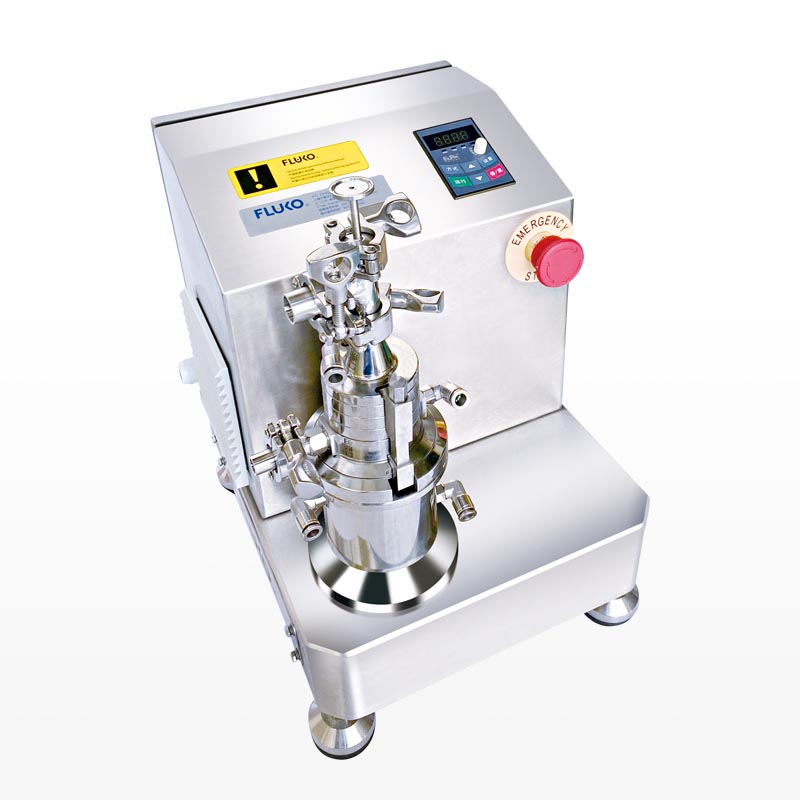
Resolving scale-up risk rests on selecting manufacturers who provide measurable, validated performance data and practical commissioning support. When reproducible lab-to-production behaviour matters, aligning your process window with equipment capability narrows development cycles and reduces batch failures; that alignment is what experienced suppliers deliver, and it is exemplified by suppliers such as FLUKO whose modular lab-to-pilot offerings and documented testing records make specification and validation straightforward.